Book of Dead Explained for India Players
Book of Dead is one of the most recognisable adventure-style slot titles in the online casino market. Its theme is built around ancient Egypt, exploration, hidden treasures, mystery symbols and a classic high-volatility structure. For Indian players, the most useful way to understand this game is not through exaggerated winning claims, but through its mechanics: how the reels work, what the special symbols do, why volatility matters, and how random outcomes shape every round.
The game is often discussed because it combines a simple slot layout with a strong adventure identity. The reels are easy to read, the symbols are visually clear, and the core mechanic does not require complicated decision-making. This makes Book of Dead accessible, but it also means players must understand that simple gameplay does not reduce risk. Every result is still generated by RNG technology, and no visual pattern can predict the next outcome.
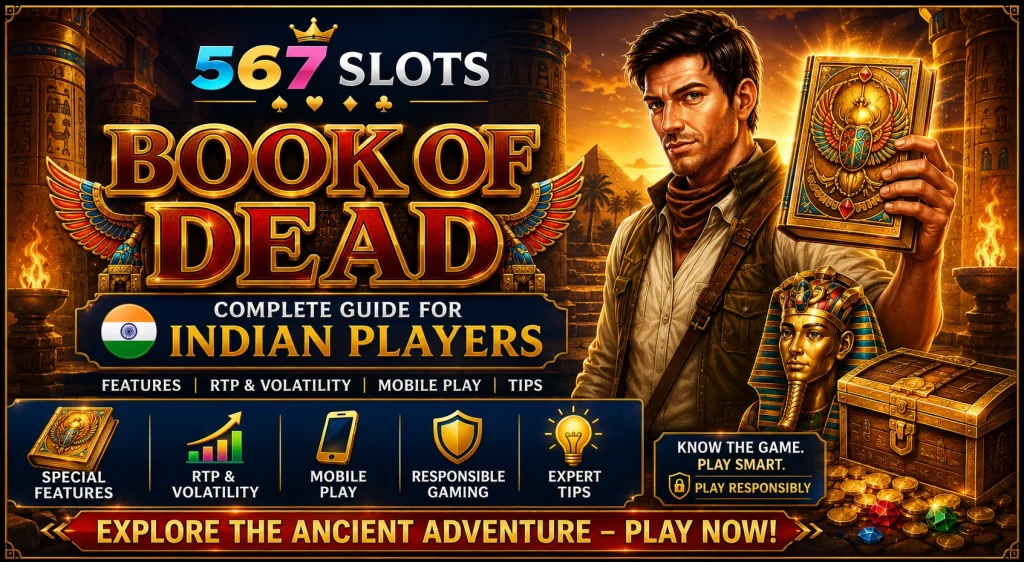
Why Book of Dead Became a Recognisable Slot Title
Book of Dead gained attention because it uses a familiar explorer theme while keeping the gameplay structure direct. The ancient temple setting, card symbols, explorer character and book symbol create a strong visual identity. Unlike some modern slots that rely on many layered mechanics, Book of Dead focuses on reels, paylines, symbol values and a special feature that can change the rhythm of a session.
For an expert-style 567 Slots page, the article should explain this clearly. Book of Dead is not difficult to understand, but it should not be described as predictable. The game’s popularity comes from presentation, pacing and feature potential, not from any player-controlled system.
How the Reels and Symbols Work
Book of Dead usually follows a five-reel video slot format with standard symbols and higher-value Egyptian-themed icons. Lower-value symbols may include card ranks, while higher-value icons usually relate to the adventure theme. The book symbol is especially important because it often works as both a scatter and a special symbol within the game’s feature structure.
A player reviewing this type of game should always check the paytable before starting any session. The paytable explains symbol values, paylines, feature conditions and any special rules. Without reading this information, it is easy to misunderstand how the game actually works.
Game theme
Book of Dead uses an ancient Egypt adventure style with explorer visuals, temple symbols and treasure-focused presentation.
RNG outcomes
Every round is generated independently, so previous spins do not influence future results or feature triggers.
Volatility profile
The game is commonly associated with uneven session rhythm, which makes budget control and realistic expectations important.
Feature awareness
Special features should be understood through the official rules and not treated as predictable or controllable events.
Why RNG Matters in Book of Dead
Random Number Generator technology is the foundation of Book of Dead. The system determines symbol positions independently for each round. This means the game does not become “ready” after a series of quiet spins, and it does not react to a player’s timing, device, account history or stake changes.
This is especially important for Indian players who may encounter slot myths online. Claims about secret patterns, lucky timing or manual control over results should be treated with caution. A serious review page should explain the game’s random structure instead of repeating unsupported claims.
Understanding Volatility Before Reading the Paytable
Volatility describes how the game may feel during a session. A higher-volatility slot can produce long quiet periods and then create stronger feature-driven moments. This does not mean the game is better or worse by itself. It simply means the session can feel less stable than lower-volatility titles.
For Book of Dead, volatility awareness is essential because the theme and feature structure can create strong expectations. Players should understand that even if the game has well-known special mechanics, those mechanics do not guarantee frequent returns during short sessions.
Where Book of Dead Fits on 567 Slots
Book of Dead belongs to the adventure and exploration side of the Slots category. It is different from fruit-themed titles because it relies on atmosphere, mystery symbols and a treasure-hunt style rather than simple fruit icons. This makes it suitable for a detailed educational review.
A useful 567 Slots article should connect Book of Dead with related pages about RNG, volatility, RTP and responsible play. Internal navigation such as FAQ, Games and Login should support user understanding, not interrupt the article with pressure-based wording. This keeps the page closer to a real expert casino guide and less like generic promotional copy.
Book of Dead Feature Structure and Session Flow
Book of Dead is often discussed because its base game is easy to understand, while its feature structure creates a more dramatic session rhythm. The game does not require complicated choices, but it does encourage players to pay attention to symbol values, scatter behaviour and the way special features may change the pace of play.
For Indian players, this balance is important. The game looks simple on the surface, but the experience can feel uneven because feature moments may not appear regularly. A professional 567 Slots review should therefore explain both the appeal and the risk. Book of Dead is popular because it is clear, thematic and memorable, but its randomness must be understood before any expectation is formed.
Why the Book Symbol Matters
The book symbol is the central icon in the game. It is usually connected with feature activation and can also act as a special symbol within the game’s rules. This makes it more important than ordinary low-value symbols.
However, the appearance of the book symbol should not be misunderstood as a signal. A near-miss, two visible books or repeated book appearances do not mean the feature is “close” in a predictable way. The system still generates each result independently.
RTP and Volatility in Book of Dead
RTP and volatility are two of the most important values to review. RTP gives a long-term theoretical percentage, while volatility explains how the result pattern may feel across sessions. Book of Dead is commonly associated with high-volatility play, so short-term outcomes can vary sharply.
This does not make the game automatically better or worse. It means players should use careful session limits and avoid assuming that a feature will arrive because a quiet period has lasted for several rounds.
Mobile Gameplay and Interface Clarity
Book of Dead works well as a mobile-focused review topic because its layout is visually readable. The reels, symbols and key controls usually translate effectively to smaller screens. For Indian players, this matters because many users access casino-style platforms primarily through smartphones.
A strong mobile experience should not only look smooth. It should keep stake settings, paytable information, balance details and responsible gaming options easy to find. If these elements are hidden or hard to read, the platform experience becomes weaker from an expert review perspective.
Why Feature-Based Slots Need Better Risk Explanation
Feature-based slots can create stronger emotional reactions than simpler games. When players wait for a special round, they may start to believe that a trigger is overdue. This belief is not supported by RNG-based mechanics.
Book of Dead should therefore be explained with direct language. The feature can make the game more exciting, but it does not make the game predictable. An expert page should help readers understand that anticipation is part of the entertainment design, not evidence of a near-certain result.
Practical Internal Navigation for 567 Slots
A useful article should connect Book of Dead to broader educational pages on 567 Slots. Readers may need clear explanations of RTP, volatility, RNG testing, responsible gaming, mobile play and account security.
A natural internal path could include educational references to App guides for mobile access, payment safety content, and broader slot category explanations. These connections should support informed reading instead of acting as forced promotional links.
Stage 1 — Base game review
Players should first examine the reel structure, paylines, stake range and symbol values before focusing on special features.
Stage 2 — Book symbol awareness
The book symbol is central to the feature structure, but its appearance does not create a predictable signal for future rounds.
Stage 3 — Feature expectation
Special features can change the rhythm of a session, but they remain random and should not be treated as guaranteed moments.
Stage 4 — RTP reading
RTP should be read as a long-term theoretical reference rather than a prediction for one player or one short session.
Stage 5 — Volatility check
High-volatility rhythm can create uneven sessions, which makes personal limits and realistic expectations essential.
Stage 6 — Responsible play decision
Players should decide budget and session time before starting, because outcome control is not possible inside the game.
Understanding High Volatility in Book of Dead Sessions
Book of Dead is frequently associated with higher volatility compared to many traditional slot titles. This means sessions can feel uneven, with longer periods of modest results followed by occasional feature-driven moments. For Indian players researching the game, volatility should be viewed as a description of gameplay rhythm rather than a promise of larger rewards.
A common mistake is assuming that a long sequence without a feature automatically increases the chance of one appearing soon. Because the game relies on RNG technology, every round remains independent. The timing of special events cannot be predicted through observation, previous results or session length.
Why Responsible Session Planning Matters More Than Chasing Features
Feature-focused slots often encourage players to keep watching for a special round. While this can make gameplay engaging, it can also lead to unrealistic expectations if players begin treating feature triggers as inevitable. A responsible approach starts with a fixed budget and a fixed amount of time before the session begins.
Book of Dead is easier to evaluate objectively when players focus on information rather than anticipation. Understanding RTP, volatility and stake range is generally more useful than trying to predict when a feature may appear.
Step 1 — Learn the symbol hierarchy
Understanding which symbols carry higher values helps players read the paytable correctly and evaluate the structure of the game before focusing on features.
Step 2 — Review the RTP information
RTP should be treated as a theoretical long-term metric. It provides context for analysis but should never be interpreted as a session guarantee.
Step 3 — Understand volatility before playing
Volatility explains why sessions may feel inconsistent. A player who understands this concept is less likely to form unrealistic expectations.
Step 4 — Analyse feature mechanics objectively
Special rounds should be reviewed through their rules and probabilities rather than assumptions about when they might appear.
Step 5 — Evaluate mobile usability and interface quality
A strong mobile experience should provide easy access to the paytable, balance information, controls and responsible gaming settings.
Step 6 — Apply responsible gaming principles
Time limits, budget controls and realistic expectations help keep gameplay within personal limits regardless of the game theme.
Popular Slot Categories Frequently Discussed by Indian Players
Players exploring Book of Dead often compare it with other major slot categories available across the market. These categories differ in visual design, volatility profiles and feature structures.
Common slot categories include:
Classic fruit-themed slots
Adventure exploration slots
Egyptian mythology slots
Megaways-style games
Jackpot-focused slots
Asian luck-themed titles
Festival-inspired slots
Multiplier-based slots
Cash collection slots
High-volatility video slots
Each category should be reviewed independently because visual themes alone do not explain how a game behaves mathematically.
Why Book of Dead Remains Relevant Despite Constant Market Changes
The online slot market changes rapidly, with new releases appearing constantly. Yet Book of Dead continues to be discussed because its design combines simplicity with a distinctive theme. Players can understand the basic structure quickly while still encountering mechanics that create variation within the gameplay experience.
For an expert-style 567 Slots article, the most valuable approach is not to focus on popularity alone. Instead, the page should explain why the game remains recognisable, how its volatility affects expectations and what readers should understand before evaluating the title themselves.
ook of Dead Final Assessment for Indian Players
Book of Dead remains one of the most recognisable adventure-style slots because it combines a simple reel structure with a strong ancient Egypt identity. For Indian players, the most important point is that the game should be understood through mechanics rather than reputation. Its theme is memorable, but the outcome model is still based on RNG, volatility and theoretical return values.
A serious 567 Slots review should explain that Book of Dead can feel exciting because of its feature structure, but no player can control when a special round appears. The correct way to evaluate the game is to read the rules, check RTP information, understand volatility and use personal limits before any real-money decision.
Why Account and Access Pages Should Stay Informational
If a reader moves from a Book of Dead article toward a Sign up page, the surrounding content should stay factual. Registration information should explain age requirements, identity checks, payment conditions, security steps and responsible gaming tools. It should not interrupt the educational article with pressure-based language.
The same applies to a Bonus page. If bonus terms are connected with slot play, readers need clear information about wagering rules, eligible games, time limits and restrictions. A professional site should make these details easy to understand before users make decisions.
How Book of Dead Fits Into a Wider Casino Content Hub
Book of Dead works well as part of a broader expert content structure because it connects naturally with many educational topics. A reader may want to compare adventure slots, understand high volatility, learn about RNG testing, or review account safety pages.
This is where internal navigation matters. A strong 567 Slots article should connect Book of Dead with guides about RTP, volatility, mobile play, safer gaming, payments and platform security. The goal is to help readers move through relevant information logically instead of pushing them toward unrealistic expectations.
What Book of Dead does well
Strong theme: The ancient Egypt setting gives the game a clear visual identity and makes it easy to recognise.
Simple layout: The reel structure is direct, so players can understand the basic format quickly.
Memorable feature design: The book symbol creates a distinctive feature focus that defines the game experience.
Mobile readability: Large symbols and straightforward controls can work effectively on smartphone screens.
What players should check first
Volatility level: Book of Dead is commonly associated with uneven session rhythm, so expectations should be realistic.
RTP details: RTP should be read as a long-term theoretical percentage, not as a prediction for one session.
Feature rules: Players should check how the book symbol works and what triggers the special round.
Limit tools: Budget controls, cooling-off options and responsible gaming settings should be easy to access.
Final Expert Verdict on Book of Dead
Book of Dead is best described as a classic adventure slot with a simple layout, strong Egyptian theme and highly recognisable feature structure. Its long-term popularity comes from a combination of visual identity and accessible mechanics, not from predictability.
For Indian players, the key lesson is clear: read the rules, understand volatility, check RTP, use limits and treat the game as entertainment only. A polished 567 Slots page should present Book of Dead with authority, but also with enough risk context to make the article credible and useful.
Book of Dead FAQ
What is Book of Dead?
Book of Dead is an adventure-style online slot built around an ancient Egypt theme, five reels, special book symbols and random outcomes generated by RNG technology.
How does the book symbol work?
The book symbol is usually connected with the game’s special feature and may also work as a scatter symbol. Its exact function should always be checked in the official paytable.
Is Book of Dead a high-volatility slot?
Book of Dead is commonly associated with higher volatility, meaning sessions can feel uneven and feature moments may not appear frequently during short play periods.
Can players predict when the feature will appear?
No. Feature triggers are controlled by RNG mechanics. Previous rounds, near-misses, timing or stake changes cannot reliably predict future outcomes.
What should Indian players check before playing?
Indian players should review the paytable, RTP details, volatility profile, stake range, feature rules and responsible gaming tools before starting any real-money session.
Does RTP guarantee a return in one session?
No. RTP is a theoretical long-term percentage calculated over a very large number of rounds. It does not guarantee what will happen in one session.
Is Book of Dead suitable for mobile play?
Book of Dead is usually easy to read on mobile because of its clear symbols, direct reel layout and simple controls, but rule panels and responsible gaming settings should still be easy to access.
How can Book of Dead be approached responsibly?
A responsible approach includes setting budget limits, using time controls, avoiding loss chasing and treating the game as entertainment rather than a predictable source of profit.






Comments